Showing posts with label Bill Ashenfelter. Show all posts

Wednesday, December 12, 2018

PSU Is 800U: World Record Edition!


We have highlighted PSU's half-mile and 800M prowess many times, from the turn of the previous Century to this year's NCAA Championship.  But here's one I didn't know about.  And the greatest Track and Field Museum Curator Mike Fanelli, just dug up another one!

Following the 1952 Olympics where Horace Ashenfelter set the world record in the 3000M Steeplechase, the team headed to Jolly Ole for a battle of Revolutionary importance.  The US team bested the Brits in a head-to-head matchup for all the marbles.

In that crew was Horace's brother Bill on the 4 x 880y team.  And they won against the home team in a world record time of 7:29.2


Friday, August 25, 2017

More Old Timey Goodness


Our Chief Laundry and Morale Officer sent along 2 separate Collegian articles highlighting some of the same names as yesterday's post celebrating Curt Stone's contributions to our heritage.

This time, additional Olympic achievements were introduced.  Herm Goffberg is submitted as a 1948 Olympian in the 10,000M.  Those who are in the know realize that Herm returned to PSU in his later years and became one of Coach Groves' favorite people in the world, serving as a grad assistant.  When he passed away,  Coach Groves was involved in making sure his remains were placed at a prominent place next to the track, (between the track and the runway where the women stretch before their workout).


Former Penn State Olympians reminisce about 'old days'


Although the Nittany Lion football players performed like champions this past weekend, the fans were graced with the presence of an even greater group of heroes.
Curtis Stone, Herman Goffberg, Horace Ashenfelter, Bill Ashenfelter and Greg Fredericks, all former Penn State track and field stars and Olympic Games participants, met after Saturday's game for a tailgate celebration of Penn State tradition and pride.
Sporting a royal blue "Nittany Lions Track" windbreaker, Goffberg, a runner in the 1948 Olympics, is the oldest living Penn State Olympian. He lived in England for 35 years after the Olympics, but fittingly decided to retire in the same place where his athletic career excelled — State College.
Goffberg then took a position with the University as the Graduate Team Manager for the Track team. Looking back on the bad shoes, track conditions and outdoor weather conditions, Goffberg laughs when hearing his college runners call the past "the good old days."
"Good old days?" said Goffberg. "They were the bad old days!"
Horace Ashenfelter, winner of the 1952 Olympic gold medal in the steeplechase, shared similar memories of his Penn State track experiences. In his days at Penn State, runners practiced outside during the winter on the original outdoor track. After a heavy blizzard, the men were still expected to run.
"The coach said, 'first you've got to shovel the track, guys,' " Horace Ashenfelter said.
Despite the technology-based inconveniences of Penn State's early track years, the gentlemen expressed pride and contentment with their time spent at Penn State.
Bill Ashenfelter, distance runner in the 1952 Olympics and brother of Horace Ashenfelter, enjoyed his Penn State years.
"We've had a lot of fun here," Ashenfelter said.
Virginia Ashenfelter (senior-marketing/international business) is the great-niece of Horace Ashenfelter and also a current triathlon participant at Penn State.
"The family's built on endurance," Virginia Ashenfelter said. "They're also very humble."
Showing this typical humility, Horace Ashenfelter spoke of his own running talent.
"I was just a fair runner, better than average, I guess," he said.
Indeed this runner was better than average, elevating himself to cross-country All-American status in 1949, 1950 and 1951.
One of only two American distance runners to make the Olympics three consecutive times (1948, 1952 and 1956), Curtis Stone spoke of his experiences running against the Russians. Amidst the anxiety of the Cold War, Stone focused solely on winning a medal.
"They were tension-filled times," fellow-Olympian Greg Fredericks said. "They never thought he would place, and he did."
Stone placed sixth in the 1948 Olympic 5,000-meter race, due to a weather problem. He would have been a medal contender if the rain had held off for five minutes, he said.

"The race was run in a terrible rainstorm," Stone said. "The cloud burst as we began."
Goffberg expressed sympathy for Stone's situation.
"The runner in front of him kicked mud up on his glasses, and he couldn't see," Goffberg said.
Greg Fredericks, representing a younger generation of Penn State runners, made the Olympic team in 1980 only to find out that he would not be able to run because of former president Jimmy Carter's Olympic boycott.
"It was an event in your life. Like Joe Paterno says, 'there are certain things you just can't control, and you can't worry about them.' "
Still, Fredericks remains a dominant figure in Penn State track and field, holding the record for the 5,000-meter and 10,000-meter race at the university.
The Olympians present at the tailgate expressed an optimistic opinion for the future of Penn State track and Olympic hopefuls.
"Penn State is a major school," said Horace Ashenfelter. "They should do well."

Thursday, August 24, 2017

The Father Of Penn State Distance Running


Curt Stone practically assembled the early Penn State teams that won championships and paved the way for the rest of us all by himself.  He personally recruited Horace Ashenfelter and his brothers. Gary Cohen interviewed the reclusive Olympian a few years ago and posted it on his great web site, garycohenrunning.com


Curt Stone — September, 2015
Curt Stone was a member of the 1948, 1952 and 1956 United States Olympic teams and the first U.S. distance runner to compete in three Olympic Games. His Olympic racing included 5,000 meters in London, England (1948), 5,000 and 10,000 meters in Helsinki, Finland (1952) and 5,000 meters in Melbourne, Australia (1956). At the inaugural Pan American Games in 1951, Curt won gold medals in the 10,000 meters and the 3,000 meter steeplechase. He won the 1948 and 1952 Olympic Trials 5,000 meters, while finishing second in 1956. Stone also won the 1952 Olympic Trials 10,000 meters. Curt won a total of 14 Olympic Trials and AAU Championships at 5,000 meters, 10,000 meters and in the 3,000 meter steeplechase. He is a 1948 graduate of Penn State University where he was runner-up at the 1946 NCAA Cross-Country championships and a member of the 1942 and 1947 championship teams. Curt was 1947 Penn Relays two-mile champion and a member of the winning four-mile relay team that same year. During World War II Stone served in the 8th Army Air Force with the 95th Bombardment Group out of Horham, England. His personal best times include: 5,000 meters – 14:39.4 and 10,000 meters – 30:33.4. Curt was inducted into the RRCA Hall of Fame in 1976. He earned a Doctoral degree and retired after 22 years as a professor at Kent State. He lives in Brooklyn, PA, has been married for 63 years to his wife, Margaret, and they a daughter, Sarah. The 92 year old is hard of hearing which prevented a telephone interview, but he was kind enough to type and e-mail his recollections in September and October, 2015.
GCR:You represented the United States at the 1948 Olympics in London in the 5,000 meters. Since it was the first Olympics in 12 years due to World War II, what was the feeling for you and others to run for our country in the land of one of our staunchest allies and where you had served during World War II?
CSThree years had passed since wartime service in Britain, so it was gratifying to find progress being made within the city of London. It seemed quite fitting that they were hosting the games, that there was an Olympic Village using a famous military camp, and that the people were optimistic and welcoming.
GCR:You placed third in your Olympic qualifying heat in 14:58.6 less than a second behind Evert Nyberg of Sweden and Vaino Koskela of Finland. After this effort how did you feel about your chances to compete with the best in the world for medals in the final?
CSI had been on a European track and field tour in Norway, Sweden, Denmark, and Scotland in 1947, and I was aware that Europeans were good competitors, especially in distance running. The qualifying rounds were rather slow times and easy running, so I was optimistic for the final.
GCR:In the final you raced to a sixth place finish. What are some of your memories as to how the race developed, your tactics and whether the bad rainstorm before the race and muddy track kept you from possibly finishing closer to or in the medals?
CSI have a picture of the start of the race and it was a dark day, the cloud burst came after the race began and I was running blind because my glasses were coated with the sticky clay. Then I was greatly embarrassed when a sheet of water cleared my glasses and I could see four or five runners had broken away. I elbowed out of the 2nd group and led the chase. The times were slow because of the rain, but still a new Olympic Record for 1st. Sixth place does merit a large diploma, so some compensation.
GCR:What else of the Olympic experience stands out including the Opening Ceremonies, other track and field competition or other events you may have attended?
CSI could usually avoid standing for the hours during the Opening Ceremonies. I finally went to the 1956 Ceremonies. To me, the competitions are the attractions. For 1948, the opportunity to watch swimming and diving was unusual as the venue was near and the athletes were allowed to enter with their identity cards. I recall going to both basketball games and boxing matches in 1956 by walking in with the U.S. Team, which I believe is no longer possible.
GCR:At the 1948 Olympic Trials you set a meet record in the 5,000 meter final in beating Jerry Thompson by half a second to make the U.S. Olympic team. How did you feel your chances were before the race and was it more exciting to make the team or to win the race?
CSThe extremely hot temperatures were a problem in 1948. I dropped out of the 10K because of the heat. I decided it was not worth it and I was O.K. for the 5K. I don’t recall being especially elated to win the race; I was more likely to be saddened by friends who didn’t make the team. I think that excessive rejoicing is rather disrespectable for the other competitors.
GCR:The Olympics were the solitary international competition until in 1951 when the inaugural Pan American Games were held in Buenos Aires, Argentina. How exciting was it to have another big meet where you could represent your country and also to win gold medals in the 3,000 meter steeplechase and the 10,000 meter run?
CSBy 1951 I had already been on several European tours and three to Brazil. The Pan Am Games were in early months as I recall, during winter times, so I was impressed to find a number of good athletes such as Whitfield, Fuchs, etc. on the team. Also there were only four or five distance runners on the team. As it turns out, the Pan Am medals and ‘diplomas’ have a special significance now. The diplomas were signed by Eva Peron among others.
GCR:At the U.S. Olympic Trials in 1952 at the Los Angeles Coliseum you finished first in the 5,000 meters and 10,000 meters. Was it exciting to again make the team or were you more focused on earning an Olympic medal?
CSI really enjoyed the 1952 Trials as I had been having bouts of Exercised Induced Asthma. No doctor seemed to know any cure, and I was completely immune in California in both San Francisco and L.A.
GCR:In the 5,000 meters Wes Santee kicked with a little over half a lap to go, but then you regained the lead and hammered out a decisive win by five seconds. How important was it to kick strong and to win the race?
CSWhen I saw Wes Santee at the 50 year reunion in 2002, he remarked, ‘Oh, you are the guy who beat me in the 5,000.’ The coaches had an opinion poll before the race, and my coach, Chick Werner, told me he was about the only one voting for me to win. Wes Santee was really a miler and almost became the first to turn the trick of the four minute mile. That was a good season in 1952, as I had two American Records in both the 10K and 5K.
GCR:Winning both the 5k and 10k is a feat that was unmatched from when you did it until Galen Rupp of Oregon duplicated it in 2012. In retrospect, how does your effort and achievement stand the test of time?
CSI was surprised to find in 2012 that the double had been that difficult. The problem has been that amateur athletes just don’t have the time to train. Horace Ashenfelter remarked to me recently that he still wonders how he found about an hour and a half a day to train during those years, and he wonders now how his wife put up with that much. Also we were not conditioned to run more than one or two races in a week’s time.
GCR:Medical issues kept you from running your best at both the 1952 and 1956 Olympics with asthma bothering you in Helsinki and appendicitis disrupting you in Melbourne. How disappointing was it to not be able to race to your potential in those final two Olympics?
CSThe medical issues in 1952 and 1956 caused great disappointment but I managed to put that aside. I recall in the 5k trials in 1952 that five runners managed to break from the group and Zatopek looked back and waved five fingers at me to indicate that I should stay with them, but I was only able to use about 75-80% of my energies because of the breathing difficulties. Bob Richards used to write a column and he mentioned this event one time, but I had never advised him of my difficulties.
GCR:These days the top runners are professional athletes and running is their career. How was it for you balancing your jobs with the training it took to be a world class distance runner?
CSDuring my senior year I decided to keep 11:00 a.m. and lunch time free, and I started taking an easy 3 mile run each day. I found that helpful, so in my first job after graduation in 1947, I managed to continue the practice. I continued with a workout that lasted from 5:00 p.m. to 6:00 p.m. or so. One of my friends from Penn State retired there and helped coach, and he told me that athletes now worked out more in a week than we used to do in 3-4 weeks. As I recall in our day an athlete had to name his work place in order to remain an eligible amateur. After I started teaching I would get up about 6:00 a.m., take a short work out and also workout with students in the p.m.
GCR:You won over ten national titles from three miles to 10,000 meters and in the steeplechase. Runners’ careers are noted for Olympic performances, fast times and championships. What does it say that you were able to win so many U.S. titles and for such a lengthy period of time over a decade?
CSMy record on a Penn State information sheet says I have 14 AAU Championships, four IC4A, six 2nd places at AAU, etc. I think one of the AAU Championships is a Canadian championship. I think the reason I lasted so long is that most of my workouts were fairly easy, and I only ran to win by a couple yards. I liked the Swedish fartlek style and trained most often on a golf course. I very rarely took off any vacation from workouts. After 1952 I added weight lifting in the a.m. and began the repetitive 200 or 400 meters.
GCR:In college at Penn State you finished in second place at the NCAA cross country meet and were a member of Penn State’s NCAA Champion team. How much fun was the comraderie of cross country and succeeding with your teammates?
CSActually I believe I had one 1st place team in 1942, a 2nd place team in 1941, and possibly a 3rd place team in 1946. I also have 7 AAU team firsts plus a 2nd place. I will send you my medal records. However, after college and a year or so at Penn State in graduate school, I usually trained alone, but missed the comradeship of team workouts.
GCR:Some of your top teammates on the 1942 NCAA Cross Country Champion team were Norman Gordon who finished fifth, Gerry Karver in ninth and McClain Smith in 13th while you were seventh overall. Have you kept in contact with your teammates over the years?
CSThree of the top five runners rom that team have established Athletic Scholarships at PSU. Horace and his wife put about a million in the new indoor track and Howie Horn and I both have scholarships I would guess of over 100 thousand. I did keep in contact over the years with my Penn State teammates, and three members of our first NCAA championship are still living: Karver, Horn and myself. Four of the top runners were Lieutenants in WWII and I was a lowly corporal.
GCR:Like many others you took a break from collegiate studies and served in World War II. Were you able to stay in good physical condition during those years and did you compete in any inter-service track meets?
CSI tried to stay in shape. After basic training and some other assignments, I ended up on a B17 Bomber Group in England. I wrote my mother for sweat clothes, shoes and a time-watch. I usually trained on paths near the bomb group, and in 1944 won the mile in the 8th ‘A.F. championships at a meet o the 1/3 mile track at Cambridge Univ. I ran in meets whenever I could get free, but some of the other members of the Finance Office were older guys who kind of resented it. I was also the 3rd Air Division 2 mile champion in 1945. The Captain who ran the 8th A.F. meet was a famous Penn State boxer, football, baseball, etc. who boxed Schmeling twice and won once, the name slips by me. After the war ended in May 1945, the services held a lot of meets in London, and I ran in a couple at White City Stadium.
GCR:You returned to the NCAA Cross Country meet in 1946 and finished a close second overall just a second behind Quentin Brelsford of Ohio Wesleyan. What were some of the highlights of that race and what was the deciding factor that led to him nipping you for the win?
CSActually, team camaraderie cost me that NCAA championship in x-country in 1946. Ashenfelter raced ahead through inexperience and missed the first turn, so Karver and I stood for a few seconds calling him back, then I had lost some 50 or so places at least and spent a lot of energy catching the leaders. Just as I caught the leaders I looked at my right and Ashenfelter was there with a glazed look, and I knew the team championship was probably lost. The deciding factor for me as an individual was probably that the last mile included a long stretch on a macadam road and I was not able to run well with my spikes. It was stupid of me that I apparently didn’t go over the course prior to the race as I might have worn flats. So the winner by less than a second as I recall was a half-miler who ironically was a fraternity brother.
GCR:Organized high school track and field was very low-key in Pennsylvania in the late 1930s and early 1940s. What were some of the highlights of your relatively few high school track meets?
CSI ran six races in high school in three years in county and district meets, and then in senior year, the 6th place at State was my 7th race. The longest race in my district was the half mile, and I ran third in my heat, but on time I was given 6th place at the state meet.
GCR:Did you do much training in high school or were you mainly running from your general physical fitness from a variety of sports?
CSIn high school we ran on the paved road beside the school. The Principal gave me a book of training from the great Indiana Coach. I think it had pictures of runners from Indiana. Each day we would run our race as I recall. Most of my training was delivering newspapers, as I would deliver both sides of the street one way and then sprint as much as 440 yards in return. Of course we played a variety of sports.
GCR:What were the main ingredients to your success that were contributed by your high school coach, Charles Berilla, who was also your school’s principal?
CSThe High School Principal instituted a strong sports emphasis when he came in 1933, with baseball in the fall with the schools in the county, and track and field for both girls and boys in the spring. There were really no winter sports other than ice skating, skiing, and sledding. There was no gymnasium for the school which was built in 1923. Somewhere the principal found a training pamphlet from the Indiana Coach which he gave to me.
GCR:What did your college coaches, Chick Werner and Bob Greaves, add to your training program that took you to the next level?
CSPenn State had a good athletic program for all male sports, I was influenced to go to Penn State because of such athletes as Norwood ‘Barney’ Ewell. I don’t think there were scholarships for athletes, except perhaps help in getting a job waiting tables, etc., All the coaches were fairly recently appointed because of the national sports scandal revealed by a study in late 1920’s done by some rich fellow perhaps Carnegie? Werner and Greaves were both college athletes from Illinois and they were starting from scratch with the athletes who tried out for the sports. I think Barney Ewell was sponsored by some wealthy individuals from his home town which is hard to believe now. What is also difficult to believe now is the number of IC4A and NCAA champions produced in those years. Remember that the war started in 1939, and U.S. athletes had little contact with European coaches or athletes. The training was pretty basic. As I recall the typical workout schedule was over distance on Monday, under distance on Tuesday, your chosen distance as a time trial on Wednesday, some quarters (about four) on Thursday, a warm up on Friday, and the track meet on Saturday.
GCR:At the 1947 Penn Relays you won the two-mile and teamed with Bill Shuman, Horace Ashenfelter and Gerry Karver to win the Four by One Mile Relay. Do you have any fond recollections of those races and do you still have your champion’s watches?
CSThe Penn Relays always started the spring season. I had two watches, one still works, but who wants to wind a watch now? I gave one Penn Relay watch to an old fraternity brother actually from Cornell. I have no idea where it is. I still have a couple Hamilton Watches from the Chicago Relays.
GCR:After graduating from Penn State and getting ready for the 1948 Olympics, did you add any new training sessions to your training regimen?
CSI mentioned earlier that I started a ‘two workouts a day’ routine on the psychological theory of more frequent workouts.
GCR:When you were working full-time continuously from the late 1940s through the 1956 Olympics, did you get to train much with your New York Athletic Club teammates or were you primarily a racing team?
CSI spent a year working in New York, mostly as a need to establish residence there, so I trained with the team members in Central Park or in NYU’s outdoor wood track in the winter. I think the NYAC is the oldest sports organization in the world and they have always sponsored a good coaching system.
GCR:What was your typical training mileage after you were out of college and what were some of your key workouts for stamina and speed?
CSBecause I often worked out alone I used the Swedish fartlek system and most often trained on a golf course. I kept a diary and I usually tried to run at least 8-9 miles each day. If I sprinted it was at the up-hill section of the golf course. I gradually added speed work and repetitive quarters or 220 yards. I liked 220 yards and might do 15 or so in a workout on a track mostly because it was on a straightaway.
GCR:There were so many big races you won, from IC4As in college through national championships. What type of tactics did you use most often to help you to race your best?
CSAs I recall I never had a pre-race plan, but would use the sound of the starter’s pistol and the initial reaction of the competition to decide on tactics or strategy. Most often I would try to save as much energy as possible for the first half of a race, and then try to equal or lower the time for the last half. I liked to get the lead a lap or two before the finish, hold off challenges, etc. and start a long sprint of 300-400 yards for the end. In Europe at first I simply tried to keep up with the leaders.
GCR:Your Penn State and NYAC teammate, Horace Ashenfelter, had an amazing performance in winning the 1952 Olympic 3,000 meter steeplechase Gold Medal in a World Record time. How was Horace as a teammate and competitor?
CSI discovered Horace while he was training to try out for the baseball team at Penn State in early 1946. There were three of us working outdoors: a POW who never regained form after being in a camp in Germany, Horace, a pilot who had served pulling targets for fighter pilots to attack, and me a finance clerk on a B17 base in England. I could see Horace’s potential, advised Chick Werner of it, and tried to get him interested in running. So we were friends and competitors from 1946 on. The first objective we had was to get his wife’s interest in the athletes and the sport itself.
GCR:You also had the good fortune to get to know the legendary Czech runner, Emil Zatopek, who won Olympic Gold medals at 5k, 10k and the marathon in 1952 along with other Olympic medals. What are some of your fond memories of Emil Zatopek?
CSEmil and I had lockers together in 1948 in London, and he complained to me in broken English of his blisters. I recently found a picture of Emil and his wife taken in 1952 in Helsinki. I will try to get some copies made on my computer. I did ask him about the Russians once when they first began international competition, and he said they were ‘primitive.’ We met for the last time in Melbourne in 1956. I did not correspond with Emil but kept hearing about him from others like Fred Wilt who did exchange letters. As I recall his repetitive running of 400 meters came originally from the training done by Emil Von Elling of NYU, which was passed on and increased by German runners. It was ultimately adopted by Emil. I would hear over the years that Emil was in Cuba, N. Vietnam, etc. After the Czech revolt in 1968 I would hear he was sweeping the streets and the worst was working in Uranium mines and being kept there for weeks at a time. I suppose the mine work was the basic cause of his early death.
GCR:You have been named to several Halls of Fame. How special is this recognition for your athletic exploits?
CSI never made the ultimate Halls of Fame, perhaps because they started long after my competitive days. I do note that it can be an expensive honor because you need to bring your family and friends. But of course it can be a nice honor. Actually I now have the problem of getting medals and trophies with some organizations that can give them a proper display.
GCR:Away from the track, you received Master’s and Doctoral degrees from Penn State and became a professor of education for 22 years at Kent State University in Ohio. How did the discipline of training and racing help you in the rigors of your studies and then helping to mold your students?
CSAs I understand it, the ability to study and train for long hours is in itself a psychological reward. There is some self-satisfaction and gratification in having both mental and physical stamina. I don’t recall trying to instill this trait in others, but instead I would regard the trait as a reward in itself.
GCR:What is your current fitness regimen and what do you do to stay as healthy as possible as you have passed the ninety year mark?
CSActually, I jogged and bicycled as long as I could and hated to give it up. I believe that having good mental health is at least equal to physical health in importance.
GCR:Is there any advice you would give to children and adults who wish to succeed in running or other sports?
CSI think both children and adults should recognize that it is important to be able to enjoy pastimes, games, and sports as participants and spectators because this give us means to control time and space. Time and space are the two concepts which make us humans, and are also the two most important concepts in our brains.
GCR:How did growing up in Pennsylvania during the Depression and World War II, the discipline of running and adversity you have faced shape your life?
CSI have been giving my daughter some of my recollections, and it is interesting to recall now some major incidents concerning the past almost 93 years of my life. A short summary of my life, the adversities, the triumphs, and the insights that I might pass on to others would be quite a long task. It appears that the major episodes in my life were usually separate from my experiences in sports, but probably I took some problems more philosophically because I had learned to accept failures in running.
GCR:Track and Field changed so much with professionalism and the tremendous influx of money into sport. With the perspective of many decades as a competitor and fan, what comments can you make about the changes?
CSThe major change in athletic competition came shortly after I retired about 1960. This was when the sport added professional characteristics. During the amateur stage which began with the IC4A (Intercollegiate Association of Amateur Athletes of America) about 1871, there were numerous track and field meets throughout the country, especially with indoor meets. There are now few indoor meets during the winter months, and this means that the average competitor no longer has the opportunity to compete. Athletics is a sport that thrives on a new group of athletes coming to age every year. The media has also lost interest in athletes. Athletes are those who ‘run, jump and throw,’ so that other sports also fail to get a new influx of sportsmen from them. Now only schools and colleges continue to encourage the amateur spirit. I met an older sports promoter a few years ago who told me the main difference now is that ‘you old guys had fun.’

Wednesday, December 7, 2016

A New Officer, A Look Back And Just A Peek Forward


We haven't had a new Officer installed in a little while and I came across this pic online...


This is Mercedes and Teddy Quinn's new dog, an adopted Jack Russell terrier (or as they will learn, terror!) named Bo (I think!).  Seeing as Teddy is our group's Director of Fun, Bo is now our Ambassador of Fun!  There is never a dull moment with a Jack.  I look forward to this year's head-to-head match-up of Bo and my Jack Spott in the basketball bracket fiasco!

The Fanelli family from Jenkintown, PA is as close as America comes to Track and Field royalty.  Mike brings us this great PSU tidbit from the last team championship for the Lions!


And coming soon will be more from the Fanellis AND one of our own Olympians when I reintroduce our 10 Questions feature (give or take a few!)

Saturday, October 24, 2015

Reconfigured Top PSU Mens Cross Country Runners Of All-Time

It took the Mathematics Intern much more time to perform the meticulous calculations to arrive at the final results of our exercise in divining the best of the best among all Penn State Cross Country runners of all-time than anyone had postulated.  In his defense, the intern is unpaid and subject to a world which is way more complicated than it should be. Anyone wishing to contribute to the coffers of the poor intern can contact me...

In review, here are the original criteria for the list:

The (Original) Criteria:
  1. All PSU runners finishing in the top 20 of an NCAA Championship Meet are included.  This, of course skews the results toward the old-timers.  Back before 1973, any team could enter the race, and there were far fewer teams and runners overall. And it ignores someone who placed 21st in 4 straight Championships! Now that would be one Heck of a runner.
  2. Points are awarded in a reverse order of their finish.  A 20th place finish is worth 1 point and a first place finish is worth 20 points.  This skews the results toward those that run in multiple NCAA Championships. But placing high still means the most.
  3. Tiebreakers: a) # of appearances in NCAAs top 20 and  b) most recent to oldest.
Our New Criteria are then superimposed upon this original list.  The new criteria involves a weighting in an effort to incorporate the competitive strength of each year's race.  Of course any criteria such as this is somewhat subjective and can cause arguments and discussions on its suitability. This is welcome! It is difficult to precisely measure whether a race in 1952 was as difficult to finish in the top 20 as compared to a race in 2006.  But a reasonable estimate can be made simply by noting the number of finishers in the race and compensating for it as compared to a standard number.  In this case the standard is the number of finishers in 1970, the year with the greatest number of runners.

New superimposed Criteria:
  • Each year's finishing point total from earlier is multiplied by a factor defined as:

# of Finishers in Race Year (x)
# of Finishers in 1970 (305) 


Here's the Original Top Ten Runners of All-Time:

  1. Robert Hollen - 17th 1951, 7th 1952, 6th 1953 for 33 points.
  2. Curtis Stone -  7th 1942, 2nd 1946 for 33 points.
  3. Alan Scharsu - 19th 1979, 7th 1980, 6th 1981 for 31 points.
  4. William Ashenfelter - 8th 1950, 4th 1951 for 30 points.
  5. Eric Carter - 9th 1985, 4th 1987 for 29 points.
  6. Gerald Karver - 9th 1942, 6th 1947 for 27 points,
  7. Norman Gordon - 11th 1941, 5th 1942 for 26 points.
  8. Horace Ashenfelter - 19th 1946, 2nd 1947 for 21 points.
  9. Greg Fredericks - 4th 1970, 20th 1971 for 18 points.
  10. Paul Stemmer - 5th 1975 for 16 points.
  11. William Smith - 5th 1938 for 16 points.
And the New Top Ten Penn State Mens Cross Country Runners of All-Time:

  1. Alan Scharsu - 19th 1979, 7th 1980, 6th 1981 for 22.2 points.
  2. Greg Fredericks - 4th 1970, 20th 1971 for 17.9 points.
  3. Eric Carter - 9th 1985, 4th 1987 for 17.1 points.
  4. Paul Stemmer - 5th 1975 for 14.1 points.
  5. Curtis Stone - 7th 1942, 2nd 1946 for 12.1 points.
  6. Robert Hollen - 17th 1951, 7th 1952, 6th 1953 for 11.0 points.
  7. Horace Ashenfelter - 19th 1946, 2nd 1947 for 10.5 points. 
  8. Gerald Karver - 9th 1942, 6th 1947 for 10.0 points.
  9. William Ashenfelter - 8th 1950, 4th 1951 for 9.6 points.
  10. Robert Snyder - 9th in 1978 for 9.5 points.
Robert Snyder 1978.

Paul Stemmer 1975.

Alan Scharsu 1978.

Greg Fredericks 1970.

Thursday, October 15, 2015

This Isn't The Right Way To Determine The Top Ten PSU Mens Cross Country Runners Of All-Time

In the spirit of the ole bar room arguments like "Who is the greatest baseball player of all-time?" (It's Pete Rose BTW!), I have concocted a ridiculous look back at the history of PSU Cross Country to try to determine the top echelon of runners.  These sorts of things are always subject to the vagaries and whims of whomever is defining the criteria.  Others can vehemently disagree.  Which is usually the whole point of the exercise.

The Criteria:
  1. All PSU runners finishing in the top 20 of an NCAA Championship Meet are included.  This, of course skews the results toward the old-timers.  Back before 1973, any team could enter the race, and there were far fewer teams and runners overall. And it ignores someone who placed 21st in 4 straight Championships! Now that would be one Heck of a runner.
  2. Points are awarded in a reverse order of their finish.  A 20th place finish is worth 1 point and a first place finish is worth 20 points.  This skews the results toward those that run in multiple NCAA Championships. But placing high still means the most.
  3. Tiebreakers: a) # of appearances in NCAAs top 20 and  b) most recent to oldest.
The Results:
  1. Robert Hollen* - 17th 1951, 7th 1952, 6th 1953 for 33 points.
  2. Curtis Stone -  7th 1942, 2nd 1946 for 33 points.
  3. Alan Scharsu - 19th 1979, 7th 1980, 6th 1981 for 31 points.
  4. William Ashenfelter - 8th 1950, 4th 1951 for 30 points.
  5. Eric Carter - 9th 1985, 4th 1987 for 29 points.
  6. Gerald Karver - 9th 1942, 6th 1947 for 27 points,
  7. Norman Gordon - 11th 1941, 5th 1942 for 26 points.
  8. Horace Ashenfelter - 19th 1946, 2nd 1947 for 21 points.
  9. Greg Fredericks - 4th 1970, 20th 1971 for 18 points.
  10. Paul Stemmer - 5th 1975 for 16 points.
  11. William Smith - 5th 1938 for 16 points. 
* Variously spelled Hellen, Holen and Hollen in each of the years results pages.  More information wanted!!
Alan Scharsu
Bill and HoraceAshenfelter, and Curt Stone

Curt Stone

Saturday, October 10, 2015

Jack Saint Clair Invitational 2015


  "To run well, you have to be a bull."
-Jack Saint Clair, about his course.


I traveled to my favorite city today to check out the refurbishment of the Belmont Plateau Cross Country courses at the Jack Saint Clair Invitational.

Jack was Penn State's team captain in 1950 when they traveled to Michigan State to upset the home team for the National Championship.  The team included Horace Ashenfelter's brothers William and Don, Robert Freebairn, Dudley Foster, William Gordon and our Long Driver himself, Al Porto!

Jack was the long-time coach of Cardinal Dougherty High School (1956-1968) and then Temple University (1967-1983).  He actually created the course at Belmont Plateau in 1963.  He passed away in 2007.

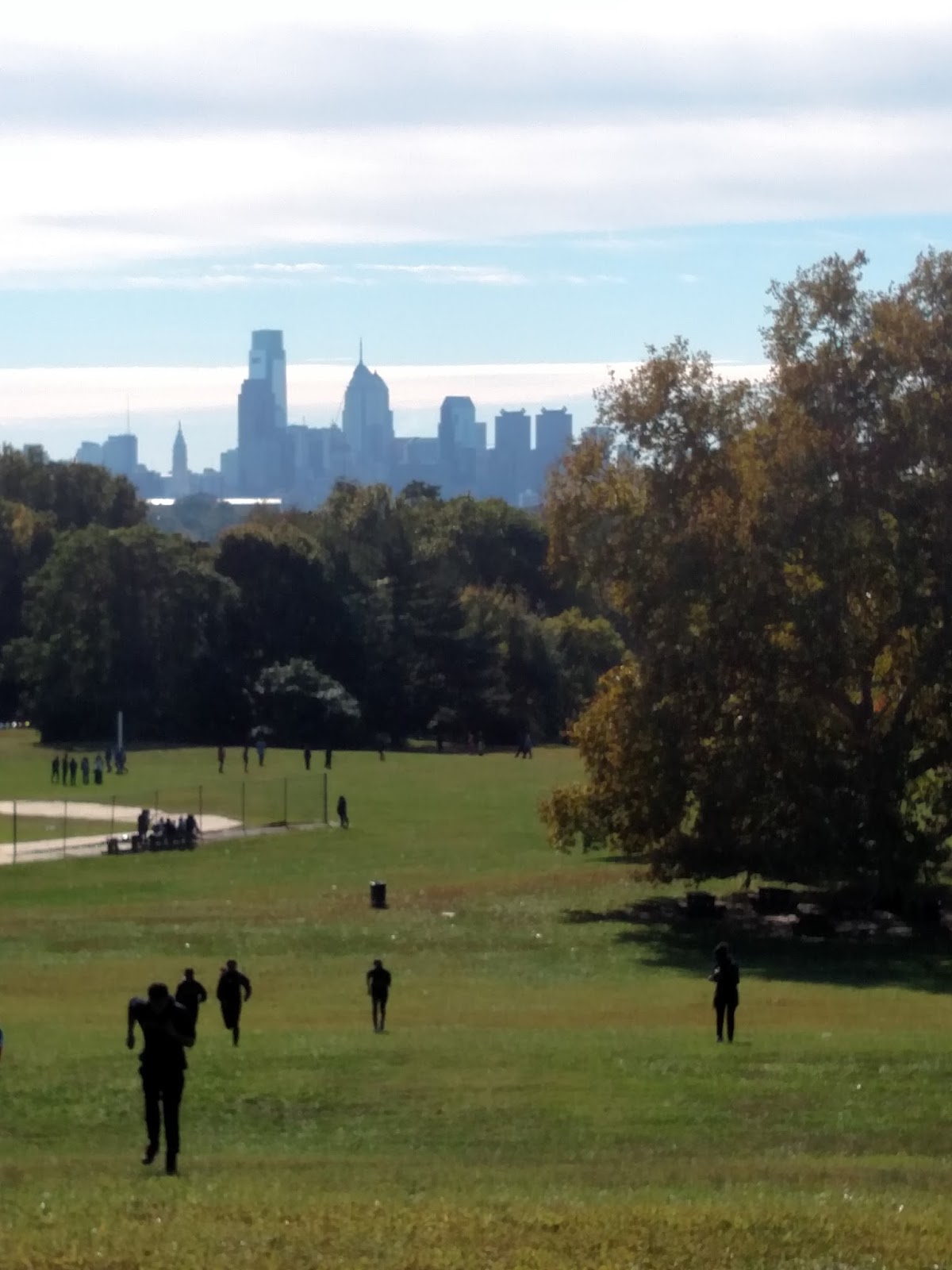
In 1963, Mr. St. Clair and coaches from Villanova University and what was then St. Joseph's College designed the five-mile college course at Belmont Plateau. It is still considered a course with everything a runner could want: steep challenging climbs, rapid descents, grass and dirt trails, and spectacular scenery, including the Philadelphia skyline.
Flagpole Hill. The flagpole is now on top of the mansion.

Signs are everywhere for all distances (except the 6K!)

On a clear day you can still see William Penn's statue atop City Hall.

The 1 Mile Mark just as you enter the woods.

Parachute Hill is much more overgrown than I remember!


Team captain 1950 NCAA Champion Nittany Lions.

Start Line is a permanent fixture with 2 large poles.

Detailed course maps are available.
 And here's the results of the 17 team 1950 NCAA XC Championships:  (PSU 53 pts., MSU 55 pts.)


Thursday, April 16, 2015

There's Only A Week Until Penn Relays!

My favorite time of year!  And to start off the festivities here at the blog with it all is a photo from our very good friend Mike Fanelli from the garage of his California home.  Mike and I have crossed paths numerous times throughout our lives, and just missed meeting face to face probably dozens of times.  I wonder if actually meeting me will really disappoint him too much?  Mike even had the good sense to marry a Nittany Lion.

Anyway here's a pic of two runners from the early 1950's at Penn Relays:


The Army runner is Richard Shea, a very accomplished runner who paid the ultimate price for America on Pork Chop Hill in Korea soon after this.  Army's track is named in his honor, Shea Stadium. Shea won the 1952 2-Mile at the Penn Relays.

The Nittany Lion is Lamont Smith, a 1953 All-American teammate of the Ashenfelters and Curt Stone, who enticed many onto the teams that won many titles.  Lamont was second in the 1952 2-Mile race at Penn.

Mike Fanelli has such a large stash of memorabilia in his garage that he went looking for more on Shea and Smith.  Although he didn't (yet) find any more, he did come up with a great program for the 1952 Millrose Games:


This stuff is gold, isn't it?

Monday, March 3, 2014

The Ones Who Started It All

Two years ago, we had the pleasure of welcoming Horace Ashenfelter, Al Porto and Bob Parsons to our Alumni Reunion and Golf Tourney.  Eight decades worth of PSU Track and Field and Cross Country Alumni got together for the very first time.  I doubt if other Alumni Groups can boast the same!

I learned several things from them at the time:
  1. Al Porto and Horace Ashenfelter are both better golfers than I.  Bob told me he no longer golfs. SO I got him beat.
  2. A long run for those 3 NCAA Champions was considered anything over 3 miles.  A 5 mile run was the longest they went.  And never on Sunday.
  3. All three of them credited Curtis Stone for encouraging them to run.
With the help of our new friend from British Columbia, George Brose, I have been pointed to some great stuff.  His Blog, Once Upon a Time in the Vest is a treasure trove of great stuff from the 50's, 60's and 70's of Track and Field, and is well worth a visit.  Prepare to spend some time.

Curt Stone is, of course, familiar to a lot of us.  He was quite a remarkable character and ran in 3 Olympics, after what he calls "his prime" during the cancelled 1944 Games. He also ran in the 1952 and 1956 Games.

Penn State Coach Chick Werner with 3 1952 Olympians, Bill Ashenfelter, Horace Ashenfelter and Curt Stone.
Here is a great 3-piece article about Curtis Stone detailing his Olympic Exploits, his PSU career and more, including some interesting tidbits about revolutionary "two-a-days and fartlek".


Curt Stone's 1948 Spikes.
Coach Chick Werner's patented shoes. Photo from Phil Scott collection.
Chamois insides of Coach Werner's sockless shoes. Photo from Phil Scott collection.


Web Statistics